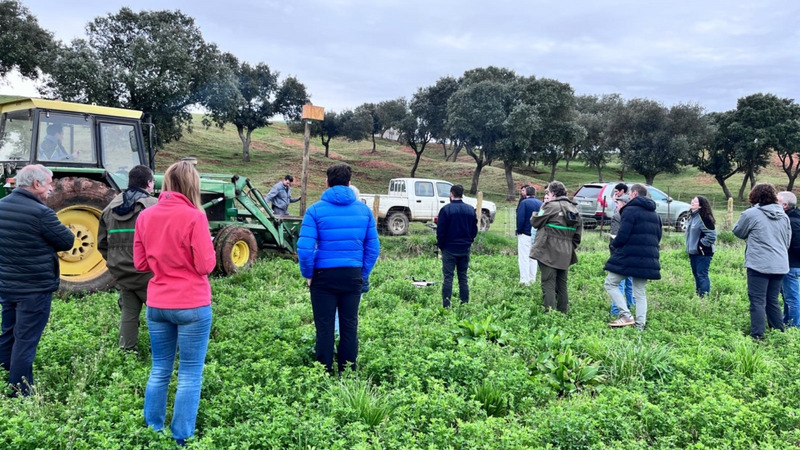
Last Friday, 20 March, the Muñovela Experimental Farm of the Institute of Natural Resources and Agrobiology of Salamanca (IRNASA-CSIC) hosted the workshop 'Biological Control of the Common Vole'. This event brought together around thirty people, including farmers, environmental officers and organisers.
About the event
The event began with an informative talk by Lorena Hernández Garavís, a technician from GREFA (Group for the Rehabilitation of Native Fauna and its Habitat). This was followed by a field demonstration, involving the installation of four nest boxes for predators, both diurnal and nocturnal, specifically: barn owls, little owls and kestrels. The event, initially scheduled for 6 March, had to be postponed due to weather conditions.
Control through natural predators
Through its Biological Vole Control Project, GREFA has extensive experience in seeking solutions to the problem caused by this rodent in Castile and León, which inflicts serious damage on farms when populations become overpopulated. The traditional use of poison has proven to be of limited effectiveness against this pest and has serious side effects for other species, such as birds of prey. For this reason, control through natural predators is emerging as the most effective solution with the least impact on the environment.
Further Information
Read the full article about the event here (in Spanish).
This event was organised by IRNASA-CSIC.
Contacts
 tap and then scroll down to the Add to Home Screen command.